3D Scanning the Carlisle Heads
Eloise Bryans, Archaeologist
Archaeology received a digital awakening in the 1950s with explorations into statistical analyses and digital databases (Zubrow 2005, 14). It was not until the 1990s that archaeology ventured into the 3D virtual space (Costopoulos 2016, 2). The advantages of 3D modelling were quickly recognised, and the techniques were adopted by many; early application saw archaeological surveys reimagined in digital 3D in documentaries and museum displays. These techniques have since been adopted by many, from large national museums to smaller and local regional museums, as state of the art digital 3D is often an accessible and cost-effective tool.
On the 8th August 2025, Dr Ardern Hulme-Beaman and I travelled to Carlisle and conducted photogrammetry on the two magnificent stone heads discovered during the Uncovering Roman Carlisle Project. Given the size of the heads and the confines of their secure storage location (and lighting conditions!), we were reliant on the versatile and flexible nature of photogrammetry 3D model creation. Structure from motion photogrammetry (just photogrammetry for short) is the process by which multiple photographs of an object are taken at different angles and are subsequently stitched and processed into a 3D model. The approaches and ideas behind it are >100 years old with early development and application seen in the turn of the 20th century in the mapping and charting of terrain from aerial photography; it was particularly used in World War 1 for mapping terrain from photographs taken from air balloons. With the underlying principles defined, the computing power that has become available in the last two decades has revolutionised the process further. The photography process for the Carlisle heads is shown below.
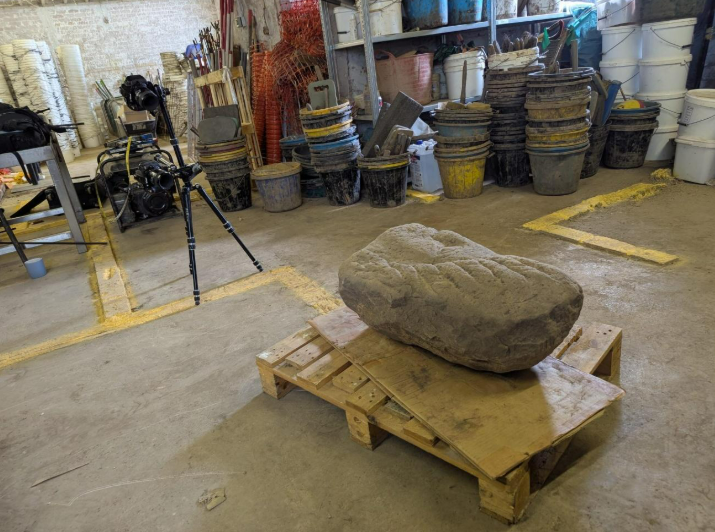
Photography set-up for the Carlisle Heads
We took approximately 950 photographs of each head to construct the model. This was probably more than is needed, but as we only had one day it was better to photograph in more detail and refine this later in post-production. In doing this, we created a model that was extremely detailed and photo realistic. It is our hope that this digital version can join a growing body of research in recognising 3D models as analytical tools. The model has the potential to highlight features of interest and perhaps reveal those previously unknown to us. Through the publishing of these models, the public will be able to make their own interpretations. This type of tangible learning would hopefully promote a deeper understanding of the past, encouraging people to reflect on their own objects, the world they were created in and how that reflects themselves and the present world.
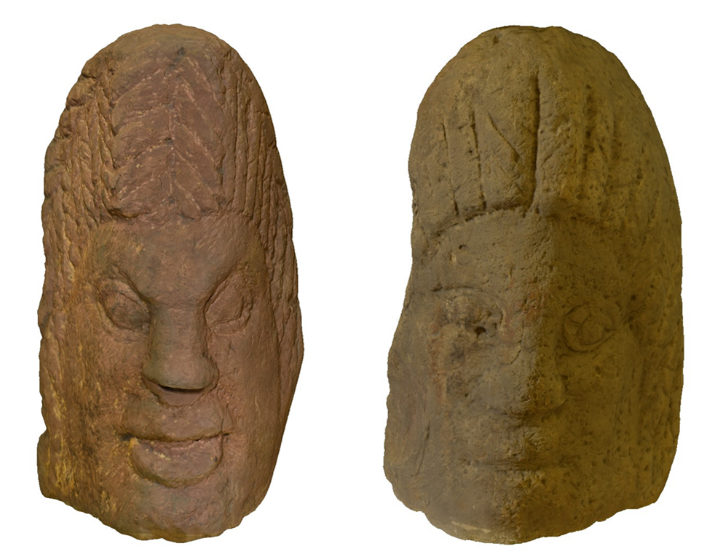
Three-dimensional models of the Carlisle heads created through photogrammetry
From all the team with Uncovering Roman Carlisle we are thankful for the in-kind support, time, and expertise given to help develop the project. We were very fortunate in 2025 for Arden and Eloise, who have helped to expand our knowledge and reach through digitising objects from the collection, and the the article written by archaeologist Eloise for the project about the Carlisle Heads. We hope to expand and share this ongoing research in future.
References:
Costopoulos, A. (2016). Digital Archaeology is Here (and Has Been for a While). Front, Digit. Humanit., 3, 4. Available at: doi: 10.3389/fdigh.2016.00004.
Zubrow, E.B.W. (2005) Digital Archaeology: A historical context. In Daly, p. (Ed.). Digital archaeology: bridging method and theory. London: Routledge, pp. 8-26.